Dressmaker Money: What Selling Actually Pays and What Is Not Published
Two income lines, three visible coin figures and no published formula. What the developer has written about money, what players report about burlap, and why no multiplier table survives checking.
Applies to: Earning coin in Dressmaker — commissions, off-rack sales and the cost side of fabric and accessories — checked October 19, 2026 against the Steam store listing, the store API, the Build 403 and Build 443 patch notes, the September 7, 2026 price announcement and public Steam discussion threads from October 18, 2026
Quick answer
Dressmaker has two ways to earn: handing a dress to the customer who ordered it, which the store description says earns "both reputation and coin", and selling one off the rack, which turns it into coin immediately. A commission shows its budget on the brief before you buy any fabric, and a sale shows its amount on the button before you press it. What is never shown is what the dress cost you, and that is where loss happens: players describe completing commissions at a loss without the interface telling them. No formula, multiplier or price table has ever been published. Burlap is the most-searched strategy and appears in no official text at all, and fabric cannot be sold back.
At a glance
Dressmaker has two ways to earn and no published arithmetic behind either. You can hand a dress to the customer who ordered it, which the store description says earns "both reputation and coin", or you can sell a dress off the rack, which converts it into coin on the spot. The commission figure is shown on the brief before you start, and the sale figure is shown on the button before you press it. What is never shown is what the dress cost you to make, and that is the gap every money guide on the internet fills with a guess.
| Question | Short answer | Basis |
|---|---|---|
| Where does coin come from? | Commissions and off-rack sales | Store description and the official Dress Complete screenshot |
| Is there a published formula for what a dress sells for? | No. Not a formula, not a multiplier, not a table | Absent from the store text, all ten announcements and all three patch notes |
| Can you see the price before committing? | Yes, on both income lines | Commission budget shown on the brief; sale amount shown on the button |
| Can you sell fabric back? | No documented way | The only documented fabric removal is discarding, which destroys it |
| Is burlap really free? | Players say so; the developer never mentions burlap at all | Player reports only |
One vocabulary note before anything else, because it causes real confusion when you go looking for help. The store description calls the currency coin — one word, mentioned once. The achievement list uses a different name for the same thing: the achievement Opulence and Excess is described as "Spend more than 5 000 gold on a successful dress". Players write "gold", "doubloons" and "money" in roughly equal measure. So the official material does not settle on one name either, and you are searching for a single system under several words.
Two income lines, and the number attached to each
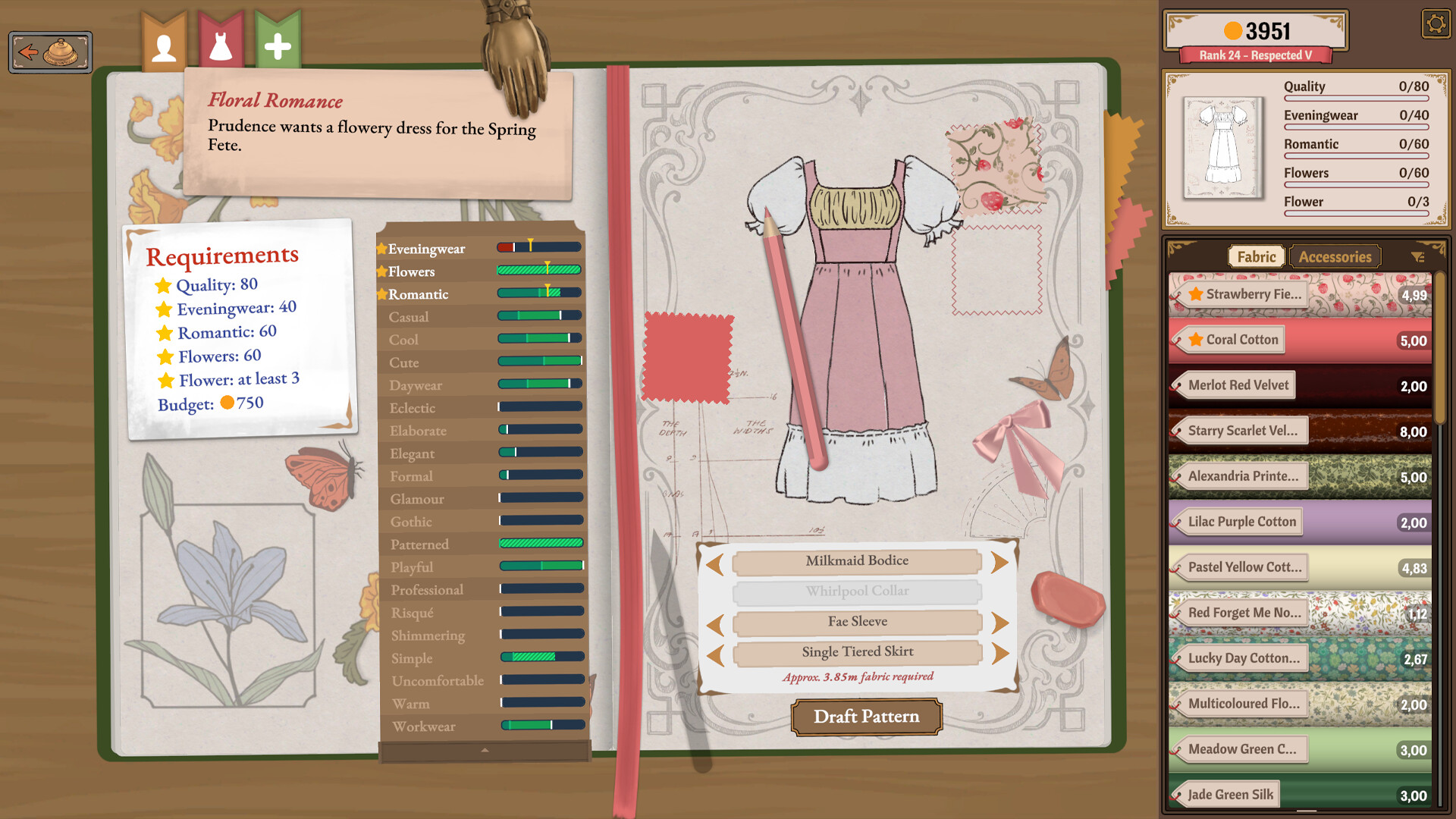
The commission line is the one the store description explains, and it explains it in a single sentence: "Turn in your dresses to your customers to gain both reputation and coin." Two rewards, one action, no amounts. The amount is not in the store text because it varies per customer — it is printed on the brief itself. The official screenshot of an open commission shows a Requirements panel listing Quality, Eveningwear, Romantic and Flowers targets next to a Budget figure of 750. That is what this customer will pay.
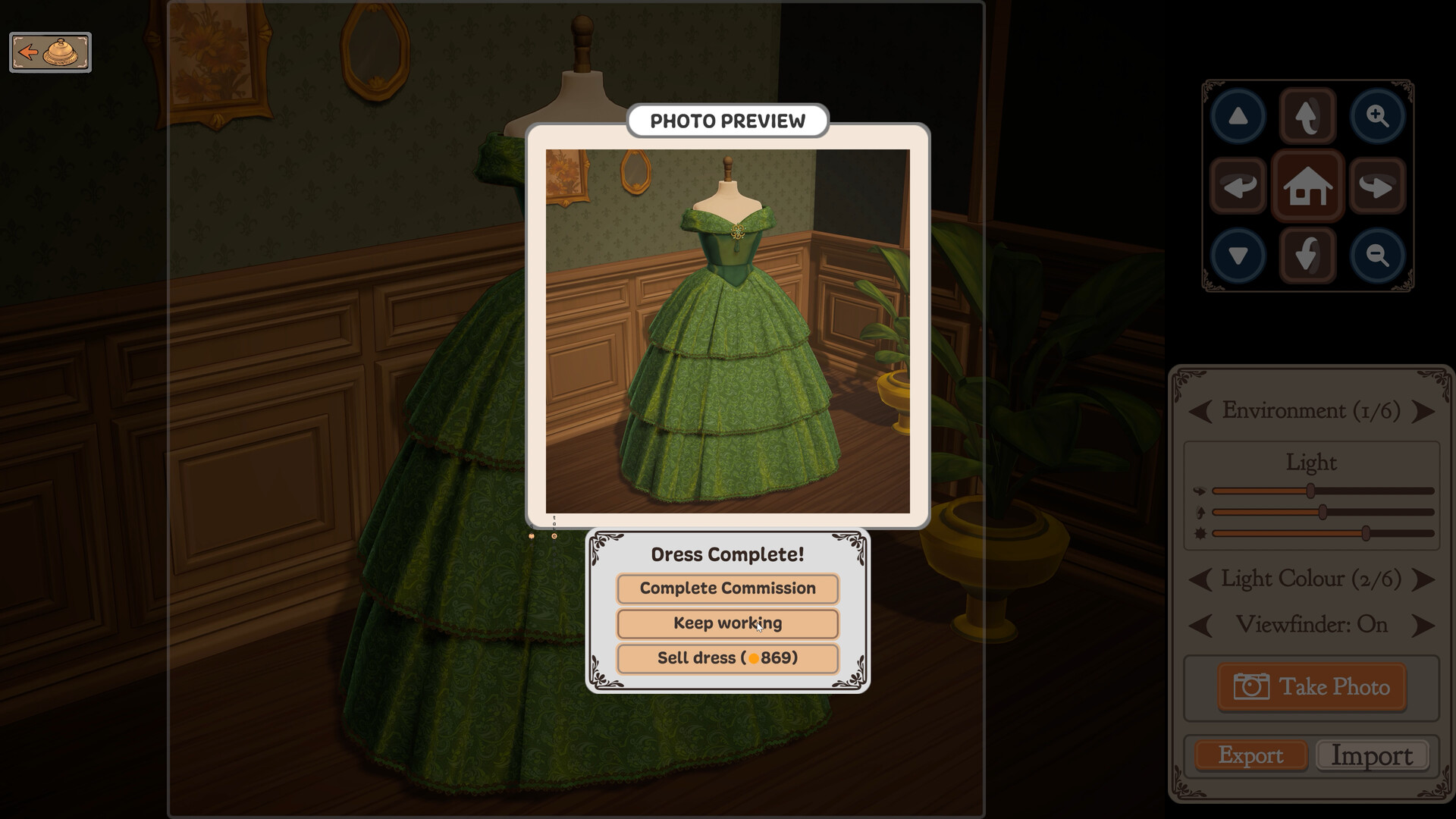
The off-rack line is the one the store description mentions without naming a reward: pre-made dresses sold from your shop window. Here the amount appears at the very end, on the third button of the Dress Complete panel, beside the label. In the official screenshot that figure is 869 for the dress on the mannequin. The sale resolves immediately — no customer arrives, nothing is queued, nothing waits for a fitting.
| Income line | When you learn the amount | What official material shows |
|---|---|---|
| Commission | When you open the brief, before buying any fabric | A Budget line inside the Requirements panel |
| Off-rack sale | At the end, on the button, before you press it | An amount in coin beside the sell option |
That asymmetry is worth internalising, because it changes how you should plan. A commission tells you the ceiling before you spend anything. An off-rack dress tells you the ceiling only after the work is done, at which point the fabric is already cut. If you are new and short of coin, the commission line is the one that lets you budget; the off-rack line is the one that lets you gamble.
There is also an older, specific promise about commission payment that is easy to miss and genuinely useful. Build 403, published September 22, 2026, contains this line:
— Cozy Lives, "Our First Patch Is Live! - Build 403", September 22, 2026
Read it as a statement about the current build: once a customer has accepted a commission, that commission pays. Failing the requirements is a scoring problem, not a payment problem. The troubleshooting page covers what "failed" actually looks like in this game, and the difference between a dress that misses a target and a commission that will not submit at all.
Everything the developer has written about money
This is a short section because the source material is short. Here is the complete official description of the economy, in the order the store page presents it:
— Steam store description, Dressmaker
That gives you a spend and a reward and nothing in between. Fabric is bought, dresses are made, dresses are turned in, coin and reputation come back. The one other economy-adjacent sentence in the whole official record is the price announcement's line about "story commissions of approximately 35 hours (excluding off-rack dresses)", which tells you that off-rack work sits outside the story budget rather than beside it.
Words that appear nowhere in the scope just described — the store text, the ten announcements and the three patch notes: money, gold, burlap, price as applied to a dress, profit, multiplier, formula. The absence is consistent enough to be a finding rather than an oversight. The developer has described what you do and declined to describe how the numbers are produced.
The three numbers on screen, and the one that is missing
Official screenshots put three different coin figures in front of you, all before any irreversible decision. The fabric shop shows a bolt of cotton with a swatch row reading "8 colors" and a purchase button at 100. The commission brief shows a budget of 750. The Dress Complete panel shows a sale value of 869. Those three figures belong to three different moments in one dress's life, which is exactly enough to plan with and not nearly enough to derive a formula from.
What is missing is the running total of what the dress in front of you has cost. That absence is not a guess on my part; it is the subject of a player's complaint, and the complaint describes the problem better than any summary could:
— AlphaGodith, Steam discussions, October 18, 2026
That is the real economic risk in Dressmaker, and it has nothing to do with finding a secret high-value dress. It is that materials you already own feel free, so a commission can be completed at a loss without the interface ever telling you. The countermeasure costs nothing and requires no formula: note the budget before you start, note roughly what you spent on fabric and accessories, and compare at the end. If the sale button offers more than the commission budget, you have a decision to make; if it offers less, the commission was the better route all along.
The cost side: metres, stock and grain
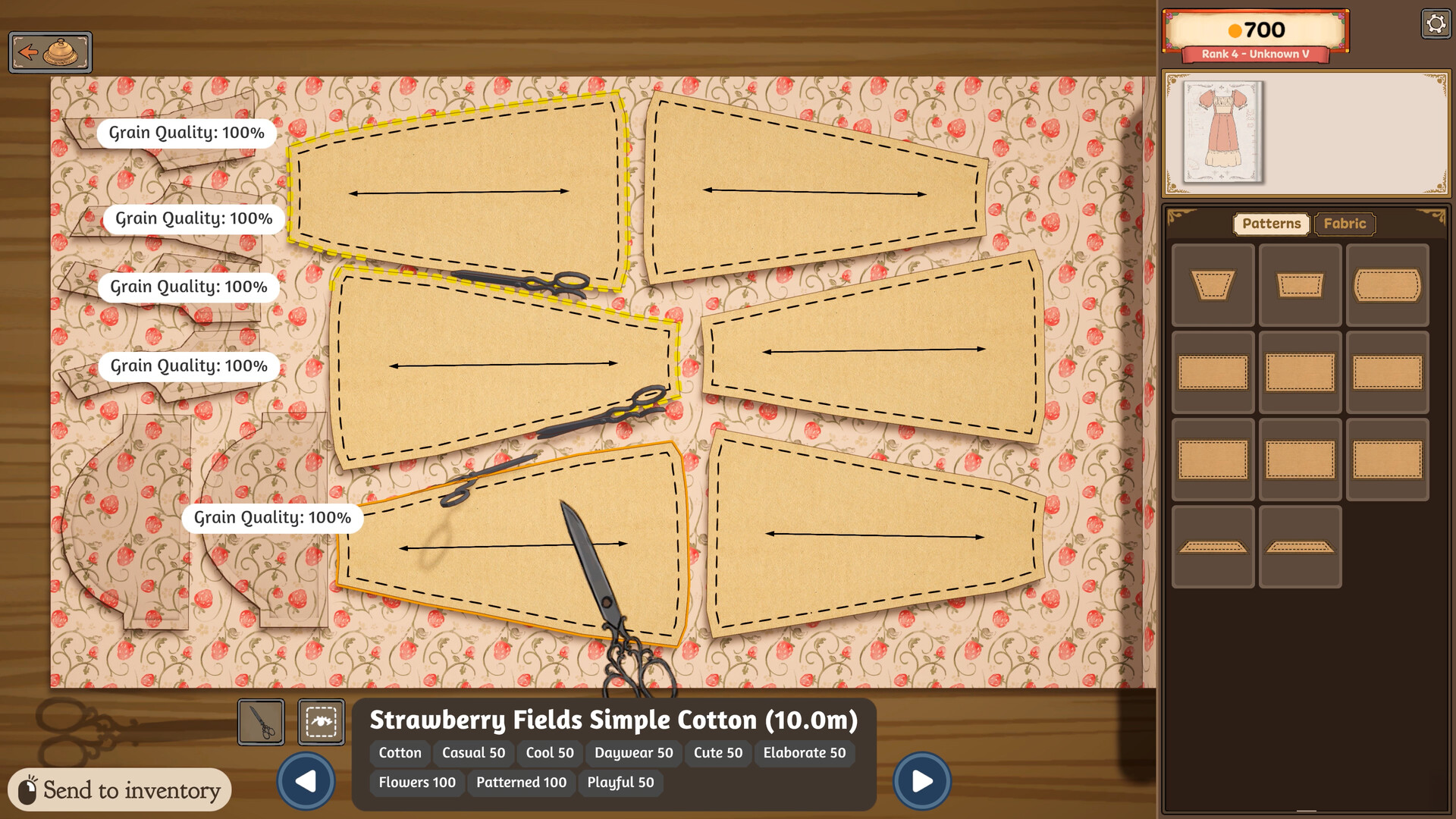
Fabric is not abstract in this game. It is bought by the metre, shown on the bolt, and cut from — the cutting-room screenshot in this article labels a bolt "Strawberry Fields Simple Cotton (10.0m)". The same unit shows up in the patch notes, in the most expensive apology in the document: "Sorry to that person who lost 5m of velvet from that misclick." Five metres of velvet is a real quantity of a real purchase, and Build 443 changed the scissors so that fabric can only be discarded when you click the discard button.
Accessories and trim deplete in the same way. Build 443 added this line: "Using the last bit of an accessory or trim now removes the entry from the inventory." That is a quality-of-life change on the surface and a cost signal underneath — stock is finite, you buy it, and you can run out of it. The same patch made trims with typed beads appear under their own filter, which matters more once you are buying in bulk than it does on a first dress.
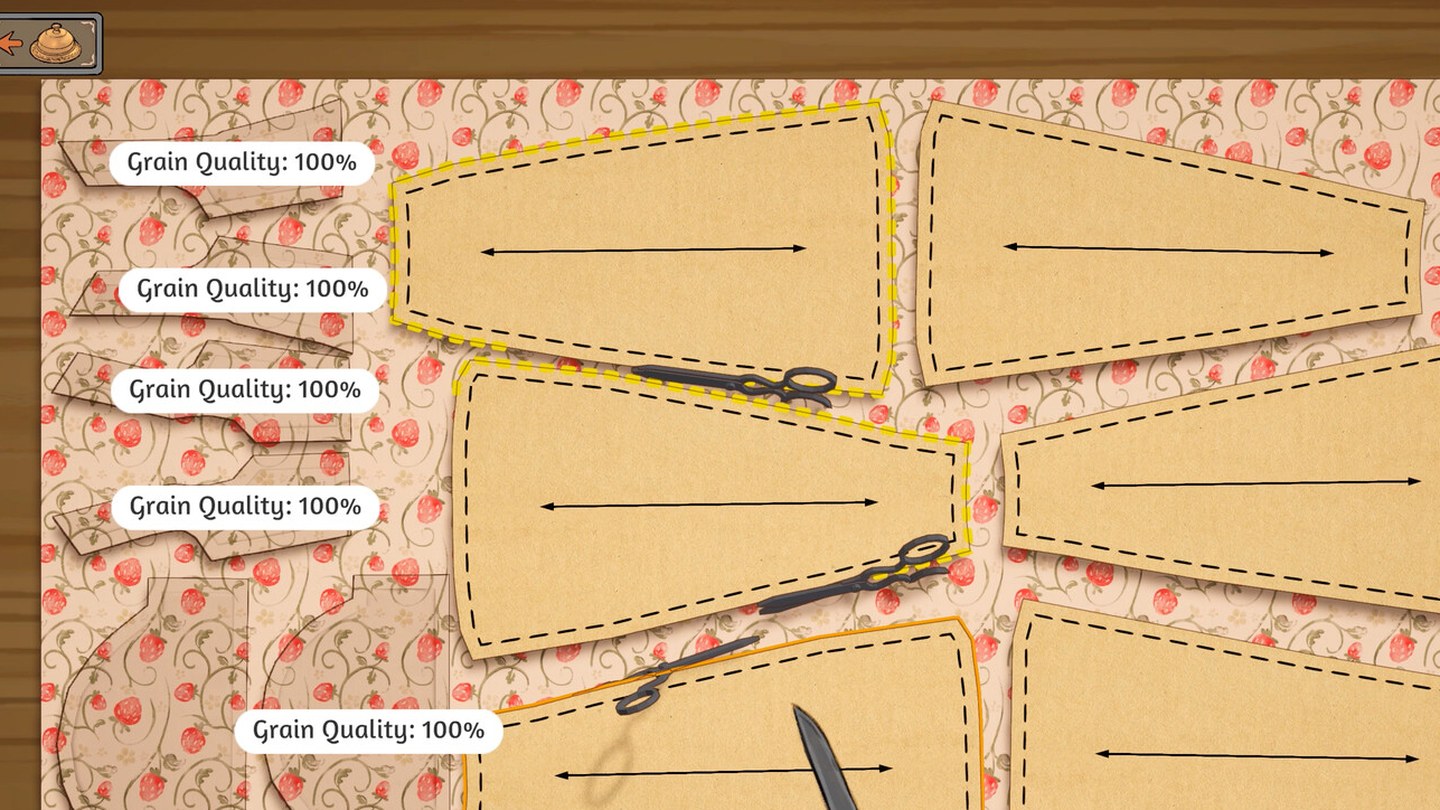
The screenshot also shows every cut panel tagged Grain Quality: 100%, and the fabric panel listing style tags with values — Flowers 100, Patterned 100, Casual 50, Cool 50, Playful 50, and so on. Those tags are the vocabulary the commission brief uses: a customer asking for Flowers 60 is asking for the tag you can read on the bolt before you buy it. They are scores, not coin. Nothing in the official record says what Grain Quality does to a sale price, and no patch note explains whether cutting against the grain costs you money, time, or only points. The quality and grain page deals with that figure on its own terms.
Burlap: the most-searched strategy in the game, and the thinnest evidence
"How to sell burlap dresses" is the most specific money question people bring to this game, and the honest answer has two halves. The mechanism half is easy: a burlap dress is sold exactly like any other off-rack dress, by choosing the sell option at Dress Complete instead of delivering it. The strategy half rests entirely on players, because the word burlap does not appear in any official text reviewed for this page.
The claim itself, quoted in full so you can see how much is being asserted and how much is being assumed:
— Exile Era, Steam discussions, October 18, 2026
Four assertions in three sentences: burlap costs nothing, you can use it for off-rack work, accessories raise what the dress brings in, and the combination turns a profit. Not one of them is accompanied by a number, and none of them comes from the developer. The logic is sound — a free input against a positive sale price is profit by definition — but the premise that burlap costs nothing is the part you would want verified, and nobody in the thread verifies it.
What this page will not do is turn that into a rate. There is no published figure for a burlap dress's sale value, because the sale value depends on things nobody has documented, and because a single sale in one save is not a rate. Treat burlap as a low-risk experiment rather than an exploit: it costs you the least if it fails, which is a different claim from "it pays the most".
The accessory-stacking thread is about spending, not earning
There is a discussion thread that money guides like to cite, and it is worth reading its title before its advice: "Spend 5000 gold on a dress achievement". The subject is a spending target, not an income strategy. The most-quoted reply in it is this one:
— Exile Era, Steam discussions, October 18, 2026
Note what "price" means in that quote. The sentence before it establishes the context: the goal was to spend 5,000 on a single dress for an achievement. "The price includes accessories" is a statement about what the dress cost to build, and "a material value of over 6000" is the total spent. Whether the same accessories raise the sale price by a comparable amount is a different question, and the thread never answers it. Citing this passage as proof that stacking jewellery makes dresses sell for more is a misreading of the source, however widely it circulates.
The rest of the thread reinforces how little is known rather than how much. Another reply, from the same discussion, describes the only workaround available: "You basically have to eyeball it." That is the state of the art on the spending side of Dressmaker's economy as of October 2026.
Why there is no formula on this page
Every game like this accumulates a folklore of multipliers: quality times material tier times accessory count, with a base value per fabric. Dressmaker has not published anything of the kind, and this page will not invent one, for a reason that is practical rather than purist. A wrong formula does not merely misinform you; it spends your fabric.
Build 443 is also a warning about any table measured before mid-October. The patch changed how colour and fabric type are scored, in a bullet that opens with its own framing: "Fix fudging for color and fabric type requirements: Before, colour and fabric type was calculated as a raw % of area of each panel relative to the total area of fabric used in the dress. Now, panels on small components (e.g. the collar or sleeves) are given a boost, so that those also make a meaningful difference." That change is about scoring, not about coin. But if sale value depends on those scores in any way — and no source says whether it does — then any pricing table built before October 14 is describing arithmetic the game no longer performs.
What you can do instead is cheaper and more reliable than finding a formula. Write down the budget. Note the fabric and accessory spend. Note what the button offers. Three dresses in, you will have your own numbers for your own habits, which beat a stranger's table because they describe the dress in front of you.
Can you sell fabric? What the record shows
People search for this specifically, and the answer is a negative that needs its evidence stated, because "no" is only useful if you can see what it rests on. No official source reviewed for this page describes selling fabric back to the shop or to anyone else. The store text describes buying fabric. The patch notes describe discarding it. Nothing describes a resale.
The one documented removal is destruction, not income: "The scissors can now only discard fabric when the 'discard fabric' button was clicked." That change was written because a player lost five metres of velvet to a misclick. Discarding costs you the purchase price; it does not return any of it.
If a spare bolt is sitting in your inventory and you want it gone, the honest position is that the official record does not describe a way to convert it into coin. Spending it on an off-rack dress — even a cheap one — is the only route to value that the documentation supports, and that is a conclusion drawn from what exists rather than a mechanic anyone has confirmed.
Still unpublished
Six questions that decide how you should play, none of them answered anywhere official:
| Question | Status |
|---|---|
| What determines a dress's sale value? | Unpublished. Three figures are visible in official material — 100 for a bolt, 750 for a budget, 869 for a sale — and no relationship between them is stated. |
| Do quality or style scores affect the price? | Unpublished. The scores exist and are visible; their effect on sale value is not described. |
| Does selling off the rack build reputation? | Unpublished. The store text attaches reputation to turning dresses in to customers and is silent about sales. |
| Can fabric be sold? | No documented route. Discarding destroys fabric; nothing describes resale. |
| What does the rank label track? | The cutting-room screenshot shows "Rank 4 · Unknown V" in the corner. No official text explains what rank measures or how it moves. |
| Do commission budgets scale with progress? | Unpublished. Budgets are shown per commission; how they are set is never described. |
There is a version of this page that answers all six with numbers and reads much better. It would also be fabricated, and the cost of acting on it is a spent bolt of silk and a commission completed at a loss. The version above is the one that survives being checked.
Sources and review scope
- Steam store listing — Dressmaker — source of the fabric-and-coin description, the "reputation and coin" line, and the screenshots showing a 100-coin bolt price, a 750 budget and an 869 sale value. Grain Quality labels, the style tag values and the rank label are read from those same screenshots, not from any text.
- Steam store API — app details — used on October 19, 2026 to read the store description verbatim rather than from a rendered page.
- Cozy Lives — October Patch Notes, Build 443, October 14, 2026 — source of the scissors discard rule, the 5m of velvet apology, the accessory and trim stock behaviour, the trim filter change, and the scoring rework for colour and fabric type.
- Cozy Lives — "Our First Patch Is Live! - Build 403", September 22, 2026 — source of the failed-commission payment fix.
- Cozy Lives — Scalding September Tea: Price Announcement, September 7, 2026 — source of "approximately 35 hours (excluding off-rack dresses)" and of the no-microtransactions statement.
- Steam discussions — scissors, discarded fabric and burlap off-rack dresses, October 18, 2026 — source of the burlap quote.
- Steam discussions — "Spend 5000 gold on a dress achievement", October 18, 2026 — source of the accessory-stacking and material-value quotes, and of "you basically have to eyeball it". Note that this thread is about a spending target, not about earning.
All ten official Steam announcements for the game were read, along with the store description and the store API record; the economy appears in the two documents and the screenshots cited above and nowhere else. The word burlap does not appear in any official text, which is why the burlap section rests on player reports and is labelled as such. No build was played to produce this page, no dress was made, sold or priced, and no income rate, profit figure or multiplier is stated anywhere above — because none has been published, and because a fabricated number here would cost a reader real progress in a game whose whole loop is resource management.
Checked on October 19, 2026 against the Steam store listing and the Steam Web API for app 4019220, the developer's own Steam announcements, the official press kit at freelives.net and the itch.io prototype page. Patch notes are quoted verbatim rather than summarised, and each quotation carries the build number and the date it was published. Player reports come from public Steam discussion threads and are labelled as player reports wherever they appear; they are never presented as developer statements, and they are never used to fill a gap the developer left open. Where a detail has not been published, the page says so instead of estimating it. No part of this game was played to produce this page.
Not independently play-tested. This is not a claim that every platform or game version was tested. Source review: Oct 19, 2026.
More Dressmaker Guides
 Dressmaker
 Off-the-Rack Dresses: Unlock, Sizing and Gifting
Off-rack dresses have no client attached, and the developer has documented almost none of it. The five official lines, what measurements change, and what nobody has answered.
 Dressmaker
 Controls After Build 443: Zoom, Pan and Orbit, Mapped
The camera was rebuilt in the October patch and most guides still describe the old one. Here are the current bindings for every scene, the exact wording of what changed, and why gamepad and trackpad users are still waiting.
 Dressmaker
: Why the Finish Button Won't Appear on a Commission
A commission that will not submit is usually an unfinished step, not a bug. The five things to check in order, what Build 443 changed about the red pins, and which parts of this the developer has never explained.
 Dressmaker
 Quality and Grain: Three Scores, One Published Sentence
Grain direction, the Quality target and fabric tags are three separate scores. Only one is explained officially, and the ceiling turns out to be routine rather than rare.
 Dressmaker
Placing Trim and Accessories in Dressmaker: What Build 443 Changed
Nine trim fixes in Build 443: fast placement, rotating the mannequin mid-placement, negative heights, end-node selection and a duplicate button. Cuffs are still hard, and the developer says so.
 Dressmaker
 Platforms: Windows and macOS Now, Switch and Mobile Only Planned
Dressmaker ships on Windows and macOS. Switch and mobile are planned in the developer's own words but carry no date, PS5 and Xbox have never been announced, and Deck is Playable rather than Verified.