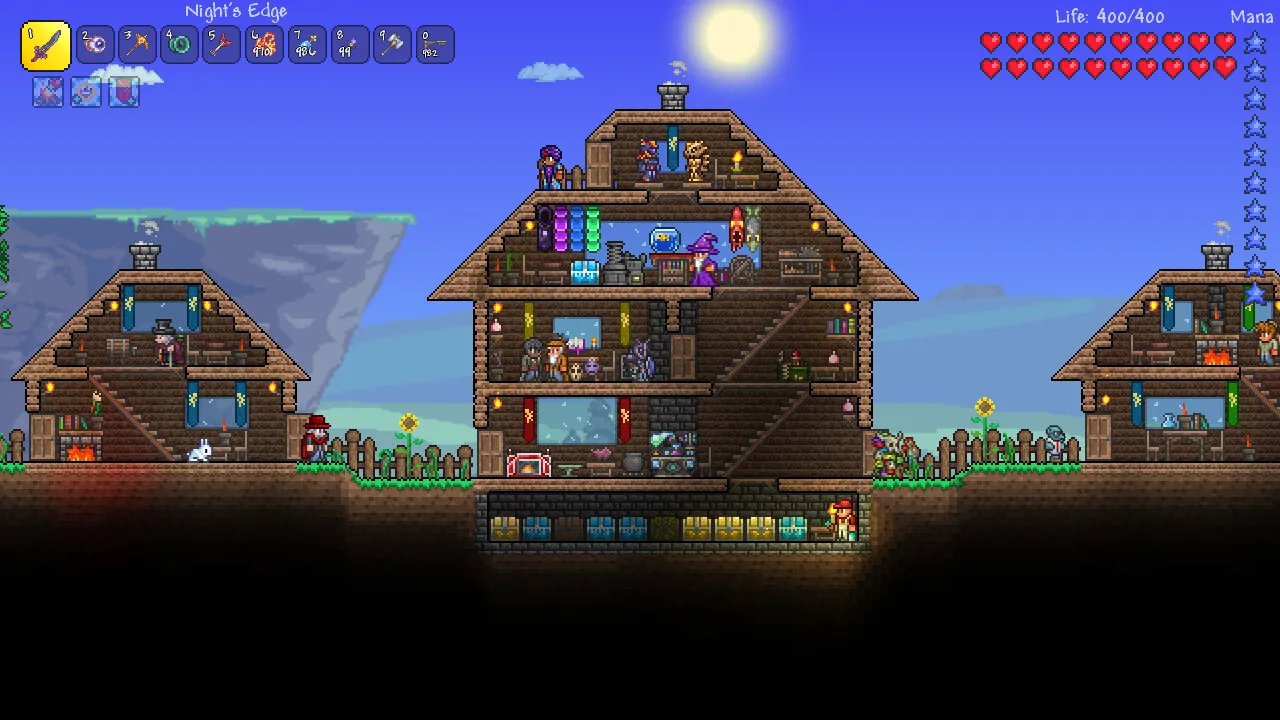
Terraria NPC happiness and housing explained
Learn the happiness multipliers, what makes a house valid, and the 1.4.5 changes to how villagers arrive.
Applies to: Happiness and housing on 1.4.5
Quick answer
Happiness is a set of multipliers applied when a shop is opened. Loving a biome gives 88% of the usual purchase price, hating one gives 112%, and an NPC with no home or living in the Dungeon, Corruption or Crimson is always charged 150%. Since 1.4.5 a villager can arrive even with no free house, but only one per day, and they leave by nightfall if no house is built.
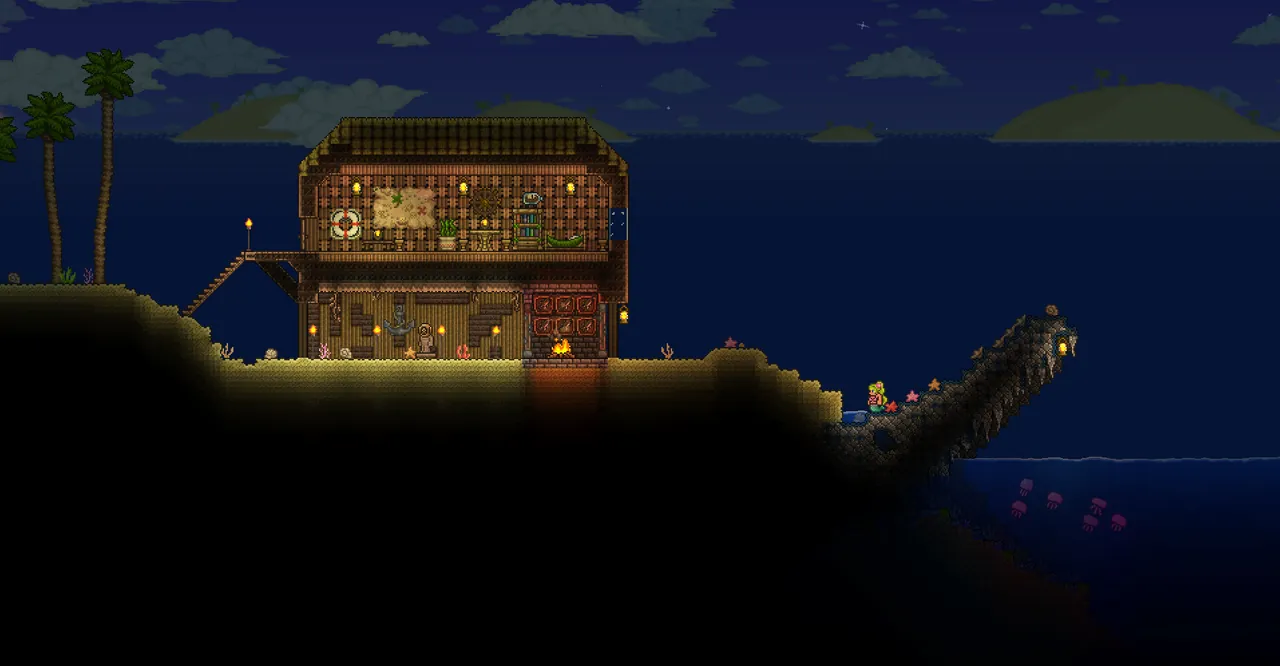
How happiness works
Terraria does not show you a happiness score. Instead, every town NPC carries a set of multipliers that are applied to shop prices the moment you open their dialogue window, and the shop interface shows a small icon summarising the result. Move an NPC, move the player, or change who lives nearby, close the window and open it again, and the numbers change immediately.
Three things feed into it:
- Biome. Where the player is standing, not where the NPC lives.
- Neighbours. How many other NPCs are within the crowding radius, and how the NPC feels about them.
- Situation. Whether the NPC actually has a home, and whether that area is somewhere they refuse to live.
Price corrections are multiplicative and rounded to the nearest 1%. The best and worst outcomes bracket a wide range: the cheapest purchases reach 75% and the best sale price reaches 133%, while the worst case is 150% purchase and 67% sale.
Price multipliers
| Factor | Purchase | Sale |
|---|---|---|
| NPC loves the biome | 88% | 114% |
| NPC likes the biome | 94% | 106% |
| NPC dislikes the biome | 106% | 94% |
| NPC hates the biome | 112% | 89% |
| A loved NPC within 25 tiles | 88% | 114% |
| A hated NPC within 25 tiles | 112% | 89% |
| Living alone (no more than 2 others within 25 tiles, no more than 3 between 25 and 120 tiles) | 95% | 105% |
| Each additional NPC beyond the crowding limit within 25 tiles | 105% | 95% |
| Lovestruck (a specific pair) | 90% | 111% |
| No home, more than 120 tiles from home, or in the Dungeon, Corruption or Crimson | 150% (fixed) | 67% (fixed) |
Two rules catch people out. First, biome preference is read from where the player stands — you can move an NPC to a liked biome and still pay a penalty by standing somewhere they hate. Second, in a mixed biome the loved and liked biomes take priority over the disliked ones, so a badly placed house is not automatically punished.
Building a valid house
A house is an enclosed room with player-placed background walls and at least one piece of valid furniture, and it has to be somewhere the NPC will accept. Two town NPCs cannot share one house, though a town pet can share with an NPC.
Two 1.4.5 changes are worth knowing:
- Houses no longer require at least one solid, non-platform block to be valid. If you previously built a floor of platforms and could not get a house to register, that is no longer the blocker.
- The housing query now gives visual feedback on whether a space is suitable, and tells you specifically when a house fails because there is nowhere to stand.
Rooms too close to Corruption or Crimson can still cause residents to leave, which connects directly to the biome spread page.
How villagers arrive
Before 1.4.5, an NPC could only move in if a valid empty house already existed. That is no longer the whole rule.
| Condition | Behaviour |
|---|---|
| No free house | A villager can still arrive, but only one per day, and only outside an eclipse or invasion. |
| Still no house by nightfall | The villager leaves. |
| Has a house | Normal arrival rules apply; NPCs do not spawn during events, or between 19:30 and 04:30. |
Two related 1.4.5 adjustments:
- A homeless NPC now shows a Housing dialogue option instead of Happiness, containing instructions on building a suitable house. If you cannot find the happiness dialogue on a new arrival, that is why.
- Villagers now take priority over town pets when respawning, and an evicted villager waits about a minute before looking for a new house.
- The Party Girl’s move-in requirement rose from 14 to 20 villagers, to account for town pets and town slimes.
Because a house is no longer required to make contact, you can meet a new NPC before you have anywhere to put them. If you want them to stay, have the room ready the same day.
Happiness and pylons
Happiness and pylons used to be tightly linked and now are less so. A pylon teleport requires at least two housed NPCs living near the pylon, but since 1.4.5 the minimum happiness requirement for an NPC to sell a pylon has been removed entirely. Full pylon rules are on the Shimmer and pylons page.
The practical summary: build a valid house near each pylon, make sure two NPCs actually live there, and worry about their personal biome preferences second — those change prices, not whether the network works.
Sources and review scope
- Official Terraria wiki — NPCs — used for the price multipliers, the no-home and bad-biome rule, housing rules and arrival behaviour.
- Official Terraria wiki — 1.4.5.0 patch notes — used for the 1.4.5 changes: houses no longer needing a solid block, the housing query feedback, the Housing dialogue for homeless NPCs, villager arrival without a free house and the Party Girl requirement change.
- Official Terraria wiki — Pylons — used for the removal of the happiness requirement when selling pylons.
The wiki is community-maintained and is not an official Re-Logic publication; it is used here as the reference for numeric mechanics, and the 1.4.5 changes are cross-read against the patch notes rather than taken from a third-party summary.
Checked against linked Re-Logic announcements, the official Terraria wiki and store listings on October 12, 2026. Dynamic details should be rechecked before publication.
Not independently play-tested. This is not a claim that every platform or game version was tested. Source review: Oct 12, 2026.
More Terraria Guides
 Terraria
 biome spread: how fast it spreads and how to stop it
Understand Corruption, Crimson and Hallow spread in Hardmode, and the containment tools that exist.
 Terraria
 Shimmer and Pylons: how both systems work
Find the Aether, use Shimmer transmutations, and build a Pylon teleport network that actually connects.
 Terraria
 world seeds and the Skyblock seed explained
Understand the 1.4.5 seed menu, what each special seed does, and how the Skyblock start works.
 Terraria
 version status: current releases and the next update
See the current version on every platform, what 1.4.5 changed, and where the crossplay update officially stands.
 Terraria
 crossplay: what works now and what is coming
Check which platforms can play together today, how joining works, and the official two-phase crossplay plan.
 Terraria
 price and where to buy it in 2026
Compare the official price on each platform, confirm there is no free version, and avoid unverified APK downloads.